


The Instruments Nobody Wanted Until Everybody Did


Every few years, without fail, something that spent a decade gathering dust on a shop wall suddenly can't stay in stock.
It's one of the strangest patterns you notice from working in the Music Industry, and it never stops happening. Suddenly it's exactly the sound a whole new generation wants, and the same model that couldn't be given away is being hunted down secondhand for silly money.
Taste in gear, it turns out, isn't really a straight line of progress toward better. It's a circle, or something closer to a pendulum, swinging between extremes that each generation rediscovers and claims as their own, usually with no idea it's already happened at least once before.
The Jazzmaster is a classic example of an instrument finding an audience Fender never intended. Launched in 1958 as an upmarket guitar for jazz players, it was largely rejected for being too bright, awkward and prone to feedback. By 1980, Fender had discontinued it.
That failure made second-hand Jazzmasters incredibly cheap, which put them into the hands of punk and indie musicians such as Elvis Costello, Tom Verlaine, Sonic Youth and My Bloody Valentine. They didn't merely tolerate its supposed faults; they made music out of them. The treble, strange harmonics and unpredictable feedback became part of the sound of indie, grunge and shoegaze.
The guitar designed for jazz players became an icon precisely because jazz players didn't want it.
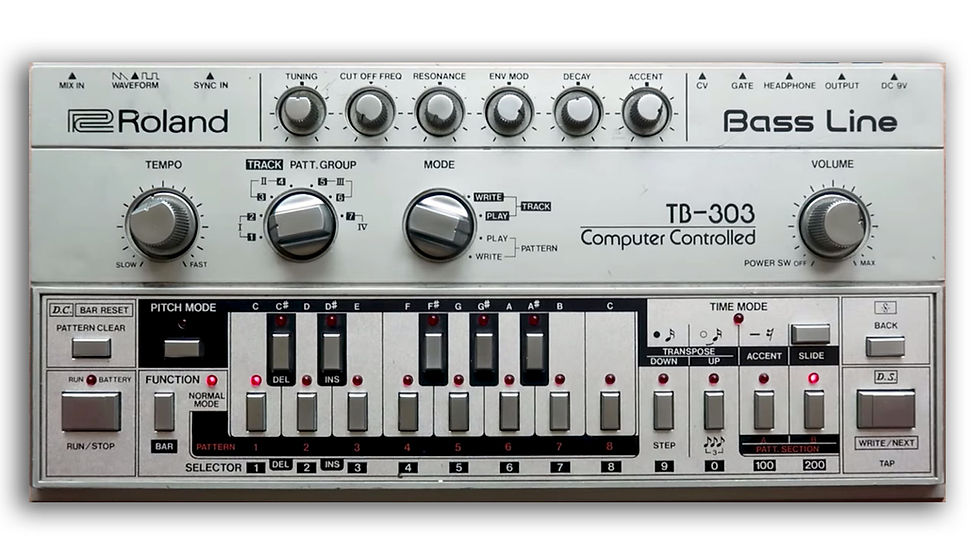
The Roland TB-303 is another instrument that became famous by failing at the job it was designed to do. Released in 1981, it was intended to provide guitarists with a programmable bass accompaniment. Unfortunately, it sounded nothing like a bass player and was remarkably difficult to program. Roland discontinued it in 1984 after selling around 10,000 units. One of which was to our Drummer at the time, Keith.
For a while, unwanted 303s could be found in second-hand shops for almost nothing. Then young Chicago musicians, most famously Phuture, stopped trying to make them sound like a real bass. They pushed the filter and resonance controls to extremes and discovered that extraordinary squelching, hypnotic sound.
A machine that failed to imitate a bass guitar ended up creating the sound of acid house, and helping to shape modern electronic dance music. The useless plastic box people once struggled to sell for £20 can now be worth many hundreds of pounds.
Watching that cycle enough times does something useful to you, if you let it. It makes you deeply suspicious of anyone declaring a sound or an instrument old hat, because Old Hat is usually just a polite way of saying not fashionable this decade. It also makes you quietly generous toward the unfashionable thing sat at the back of the shop, because you've learned, that unfashionable and bad were never actually the same claim.
If you want to know what's going to matter again in ten years, don't look at what's selling right now. Look at what just stopped selling….


Comments